Follow the Dots and Nab the Killer
- Vijay Lakshmi

- Apr 1, 2001
- 4 min read
It's called the Captain of Death. Tuberculosis kills one person every minute in India. Annually, 2 million people in India develop TB and nearly 500,000 die from it. India has more TB cases than any other country in the world and the World Health Organisation (WHO) has declared TB a global emergency.
There's more: Over 300,000 children are forced to leave school each year because of their parents' TB, and more than 100,000 women with TB are rejected by their families due to social stigma. The economic cost of the disease to India is estimated at more than US $2 billion per annum.
While the government introduced the National TB elimination Program in 1963, there have been some commendable efforts by private individuals, trust hospitals and NGOs to root out the highly infectious disease by adopting the DOTS strategy (Direct Observation Treatment Short Course) recommended by the WHO, thanks to its higher compliance and cure rates.
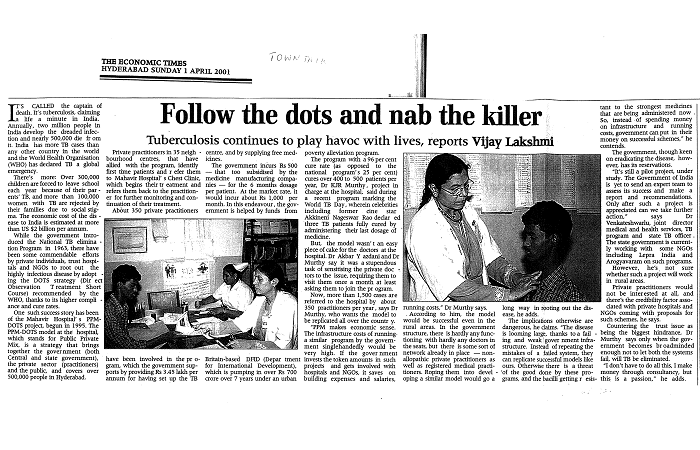
One such success story has been of the Mahavir Hospital's PPM-DOTS project, begun in 1995. The PPM-DOTS model at the hospital, which stands for Public Private Mix, is a strategy that brings together the government (both Central and state government), the private sector (practitioners) and the public, and covers over 500,000 people in Hyderabad.
Private practitioners in 35 neighborhood centers, that have allied with the program, identify first time patients and refer them to Mahavir Hospital's Chest Clinic, which begins their treatment and refers them back to the practitioner for further monitoring and continuation of their treatment.
About 350 private practitioners have been involved in the program, which the government supports by providing Rs 3.45 lakhs per annum for having set up the TB centre, and by supplying free medicines.
The government incurs Rs 500 -- that too subsidised by the medicine manufacturing companies -- for the 6 months dosage per patient. (At the market rate, it would incur about Rs 1,000 per month. In this endeavour, the government is helped by funds from Britain-based DFID (Department for International Development), which is pumping in over Rs 700 crore over 7 years under an urban poverty alleviation program.
The program with a 96 per cent cure rate (as opposed to the national program's 25 per cent) cures over 400 to 500 patients per year, Dr KJR Murthy, project in-charge at the hospital, said during a recent program marking the World TB Day, wherein celebrities including former cine star Akkineni Nageswar Rao declared three TB patients fully cured by administering their last dosage of medicine.
But, the model wasn't an easy piece of cake for the doctors at the hospital. Dr Akbar Yazdani and Dr Murthy say it was a stupendous task of sensitizing the private doctors to the issue, requiring them to visit them once a month at least asking them to join the program.
Now, more than 1,500 cases are referred to the hospital by about 350 practitioners per year, says Dr Murthy, who wants the model to be replicated all over the country.
"PPM makes economic sense. The infrastructure costs of running a similar program by the government single handedly would be very high. If the government invests the token amounts in such projects and gets involved with hospitals and NGOs, it saves on building expenses and salaries, running costs," Dr Murthy says.
According to him, the model would be successful even in the rural areas. In the government structure, there is hardly any functioning with hardly any doctors in the seats, but there is some sort of network already in place -- non-allopathic private practitioners as well as registered medical practitioners. Roping them into developing a similar model would go a long way in rooting out the disease, he adds.
The implications otherwise are dangerous, he claims. "The disease is looming large, thanks to a failing and weak government infrastructure. Instead of repeating the mistakes of a failed system, they can replicate successful models like ours. Otherwise there is a threat of the good done by these programs, and the bacillii getting resistant to the strongest medicines that are being administered now. So, instead of spending money on infrastructure and running costs, government can put in their money on successful schemes," he contends.
The government, though keen on eradicating the disease, however, has its reservations.
"It's still a pilot project, under study. The Government of India is yet to send an expert team to assess its success and make a report and recommendations. Only after such a project is appreciated can we take further action," says Dr Venkateshwarlu, Joint Director Medical and Health Servics, TB Program and State TB Officer. The state government is currently working with some NGOs including Lepra India and Arogyavaram on such programs.
However, he's not sure whether such a project will work in rural areas.
Private practioners would not be interested at all, and there's the credibility factor associated with private hospitals and NGOs coming with proposals for such schemes, he says.
Countering the trust issue as being the biggest hindrance, Dr Murthy says only when the government becomes broadminded enough not to let both the systems fail, will TB be eliminated.
"I don't have to do all this work, I make money through consultancy, but this is a passion," Dr Murthy adds.

Comments